.svg)
The global Food & Beverage (F&B) industry is undergoing a period of transformation driven by shifting consumer preferences, supply chain evolution, and a growing emphasis on sustainability and health.
Global F&B Market (2025)
Canadian F&B Sales (2025)
Canadian Manufacturing Sales Related to F&B
In this edition, we turn our focus to the Food & Beverage (F&B) industry—an essential, evolving sector undergoing significant transformation amid shifting consumer values, inflationary pressures, and growing demand for sustainable innovation.
As always, our goal with this report is to surface key trends, opportunities, and challenges for early-stage investing. Whether you’re an investor seeking high-potential sectors or an entrepreneur building in F&B, this deep dive will equip you with valuable context and timely insights to help guide your decision-making.
The global Food & Beverage (F&B) industry is undergoing a period of transformation driven by shifting consumer preferences, supply chain evolution, and a growing emphasis on sustainability and health. In 2025, the global food and beverage market is projected to exceed US$8.3 trillion, with expectations to reach over US$11 trillion by 2028, according to Statista. This growth is fueled by rising demand for functional foods, plant-based alternatives, and convenience-driven products—particularly in North America, Asia-Pacific, and Europe.
Canada’s domestic F&B industry reflects both the resilience and the realignment taking place globally. While overall volume consumption in Canada is declining—down 1.5% in 2024 and projected to drop further in 2025—total sales are expected to rise modestly, reaching $168.8 billion, according to Farm Credit Canada. This divergence between volume and value reflects inflationary pricing but also signals increasing consumer willingness to pay more for sustainable, health-focused, and premium-quality products.
At the same time, categories like dairy and confectionery are outperforming others, with projected year-over-year growth of 8.3% and 10% respectively4. Conversely, beverages—including alcohol—are seeing slight contractions, as consumer preferences shift toward wellness-oriented, non-alcoholic, and low-sugar alternatives5. These shifts align with macro trends seen globally, where traditional CPG brands are retooling their portfolios to meet the demands of a more health-conscious, sustainability-focused audience.
Private markets are responding in kind. From craft distilleries and plant-based startups to AI-enabled supply chain platforms, capital is flowing into innovative F&B businesses that are reimagining how food is sourced, packaged, and consumed. At the same time, the rise of alternative financing models—such as equity crowdfunding—is giving consumer brands more direct access to capital and enabling retail investors to participate in the next wave of growth.
As global competition intensifies and consumer values evolve, Canada’s F&B sector faces a critical inflection point: brands that innovate around health, sustainability, and value will be best positioned to lead. The question is not whether the sector will grow, but which companies will define its future—and who will invest in them.
The most prominent trend in Canadian F&B is the growing demand for affordable yet high‑quality products. Nearly 40% of Canadians say they plan to buy cheaper items in 2025, but they aren’t willing to compromise on nutrition or values3. This is fueling the rise of premium private-label offerings—products that deliver trusted performance, sustainability, and nutrition at accessible prices.
Sustainability, particularly packaging innovation, remains top of mind. Consumer demand and regulatory pressure are accelerating compostable, recyclable or biodegradable materials, QR-coded traceability, minimalist messaging, and even “dopaminergic” packaging—all core differentiators in tomorrow’s marketplace.
Geopolitical tensions and tariff threats are increasingly impacting Canada’s F&B sector. In early 2025, the U.S. threatened—and briefly imposed—25% tariffs on Canadian agricultural exports. Canada swiftly responded with retaliatory duties on U.S. imports such as orange juice, spirits, and paper products. This has fueled uncertainty: smaller domestic processors warn of rising costs, squeezed margins, disrupted supply chains, and even closures. Sectors like specialty food, confectionery, beer, and preservatives, which rely heavily on U.S. inputs or exports, are particularly vulnerable.
On the policy front, Canada’s entrenched supply managed systems—especially in dairy and poultry—are under scrutiny in USMCA negotiations. American leaders have criticized Canada’s high dairy tariffs (nearly 300% on butter and 245% on cheese)4. While Canadian Parliament recently reaffirmed protection of supply management, trade pressure remains a looming threat.
The collective effect? Rising input costs, an inflationary environment, and significant uncertainty. But it also fuels the drive for supply-chain resilience, import substitution, and the expansion of processing capacity—especially by local and sustainable brands.
Meanwhile, functional foods—like collagen-infused beverages, protein-rich snacks, precision-nutrition, and plant-based alternatives—continue gaining momentum. Consumers are increasingly seeking healthy, on-the-go products that deliver benefits beyond basic nutrition. This aligns with broader global trends where wellness and functional innovation dominate new product launches.
Private capital is playing an increasingly important role in shaping the next generation of Food & Beverage brands—both in Canada and globally. While the sector has historically been underserved by venture capital compared to categories like fintech and SaaS, that trend is starting to shift. As investors look beyond traditional tech to sectors with strong fundamentals and real-world demand, Food & Beverage is emerging as a compelling asset class with proven resilience and outsized upside.
According to PitchBook, global venture capital investment in Food & Beverage reached US$48 billion in 2024, up from $42 billion in 2023. Much of this growth is being driven by demand for health-forward, sustainable, and clean-label products—particularly in functional beverages, plant-based foods, and climate-smart agtech. In North America alone, FoodTech and beverage-focused startups collectively raised over US$7.2 billion in 2024, fueled by consumer interest and the return of category-specific funds6.
Here in Canada, the Food & Beverage sector accounted for over $13 billion in manufacturing GDP in 2024, making it the largest manufacturing sector in the country by output7. Canadian exports of packaged foods and beverages topped $48 billion, placing Canada in the global top ten for food exporters7. However, early-stage capital access remains uneven, especially for consumer brands not yet connected to traditional VC pipelines.
This is where equity crowdfunding is helping to close the gap.
One standout success story is Sheringham Distillery, a craft spirits brand from Vancouver Island that raised over $1.2 million on FrontFundr in 2024, tripling its original target. The campaign attracted both everyday fans and high-net-worth investors, with nearly 50% of the capital coming from accredited individuals—including three $100,000 cheques. Sheringham’s founder-led approach, deep local roots, and award-winning product line (including the globally recognized Seaside Gin) made it a natural fit for community investment. Their campaign highlights the power of brand affinity and direct engagement in mobilizing capital for growth.
Sheringham’s raise exemplifies a broader trend: mission-aligned Food & Beverage companies are no longer just bootstrapping—they’re scaling, with the help of their biggest believers. And they’re not alone.
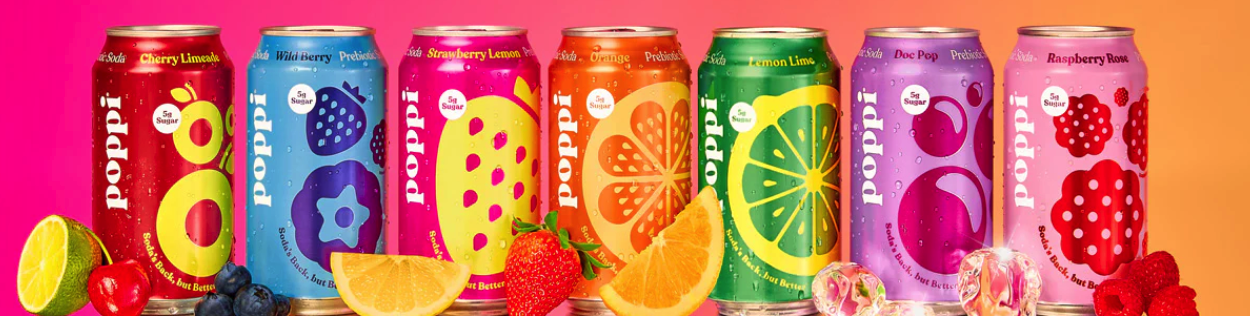
One of the most striking global case studies in recent Food & Beverage success is Poppi, the Texas-based prebiotic soda company that scaled from humble beginnings to a $1.95 billion acquisition by PepsiCo in 20258.
Founded by Allison and Stephen Ellsworth, Poppi began as a personal wellness journey—formulating sodas that incorporated apple cider vinegar and fruit-forward flavors with zero refined sugar. Originally sold at farmers markets under the name “Mother,” the brand quickly gained traction for its health benefits and clean-label appeal. In 2020, Poppi rebranded, landed a spot on Shark Tank, and soon after, secured seed investment from celebrities like the D’Amelio family, 7G Capital, and CAVU Venture Partners8.
What followed was explosive omnichannel growth9:
PepsiCo’s acquisition wasn’t just a validation of Poppi’s brand; it was a signal that the functional beverage market is entering a new era. Health-forward, digitally native, community-driven brands are now commanding valuations and exits traditionally reserved for tech startups.
For Canadian founders and investors, Poppi serves as a powerful blueprint:
The Canadian Food & Beverage sector may be growing slowly, but it is evolving rapidly. As consumers demand more sustainable, affordable, and functional products, companies that adapt to these preferences—through packaging innovation, value-aligned branding, and health-forward product development—will lead the next chapter of industry growth.


.png)